 US & Canada:
  Email:


 Access IFU & SDS
Summary & Explanation
{"type":"root","children":[{"type":"paragraph","children":[{"type":"text","value":"Cyclin E1 forms a complex with and functions as a regulatory subunit of CDK2, whose activity is required for cell cycle G1/S transition phase of the cell cycle that determines cell division. The Cyclin E/CDK2 complex phosphorylates p27Kip1 (an inhibitor of Cyclin D), tagging it for degradation and thus promoting expression of Cyclin A, allowing progression to the S phase. This protein accumulates at the G1-S phase boundary and is degraded as cells progress through S phase. Apart from the function in cell cycle progression, cyclin E/CDK2 plays a role in the centrosome cycle by phosphorylating nucleophosmin (NPM). NPM is then released from binding to an unduplicated centrosome, thereby triggering duplication. Cyclin E/CDK2 has also been shown to regulate the apoptotic response to DNA damage via phosphorylation of FOXO1."}]},{"type":"paragraph","children":[{"type":"text","value":"Overexpression of Cyclin E correlates with tumorigenesis. It is involved in various types of cancers, including breast, colon, bladder, skin, and lung cancer."}]}]}
Antibody Type
Rabbit Monoclonal
Clone
EP126
Isotype
IgG
Localization
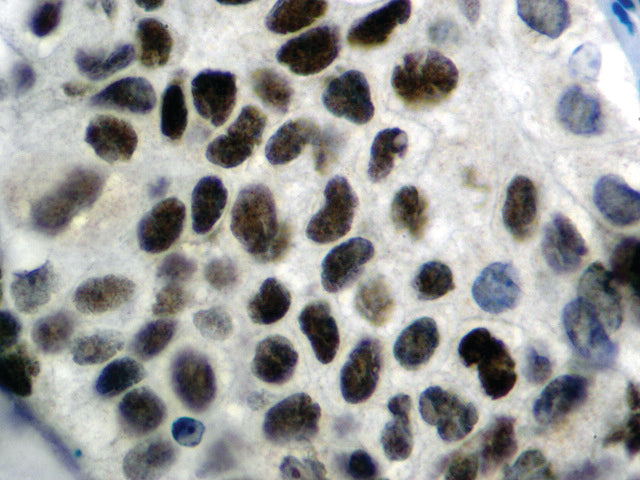
Nuclear
Dilution
1:50-1:200
Species Reactivity
Human
Immunogen
Synthetic peptide corresponding to residues of human Cyclin E1 protein.