 US & Canada:
  Email:


 Access IFU & SDS
Summary & Explanation
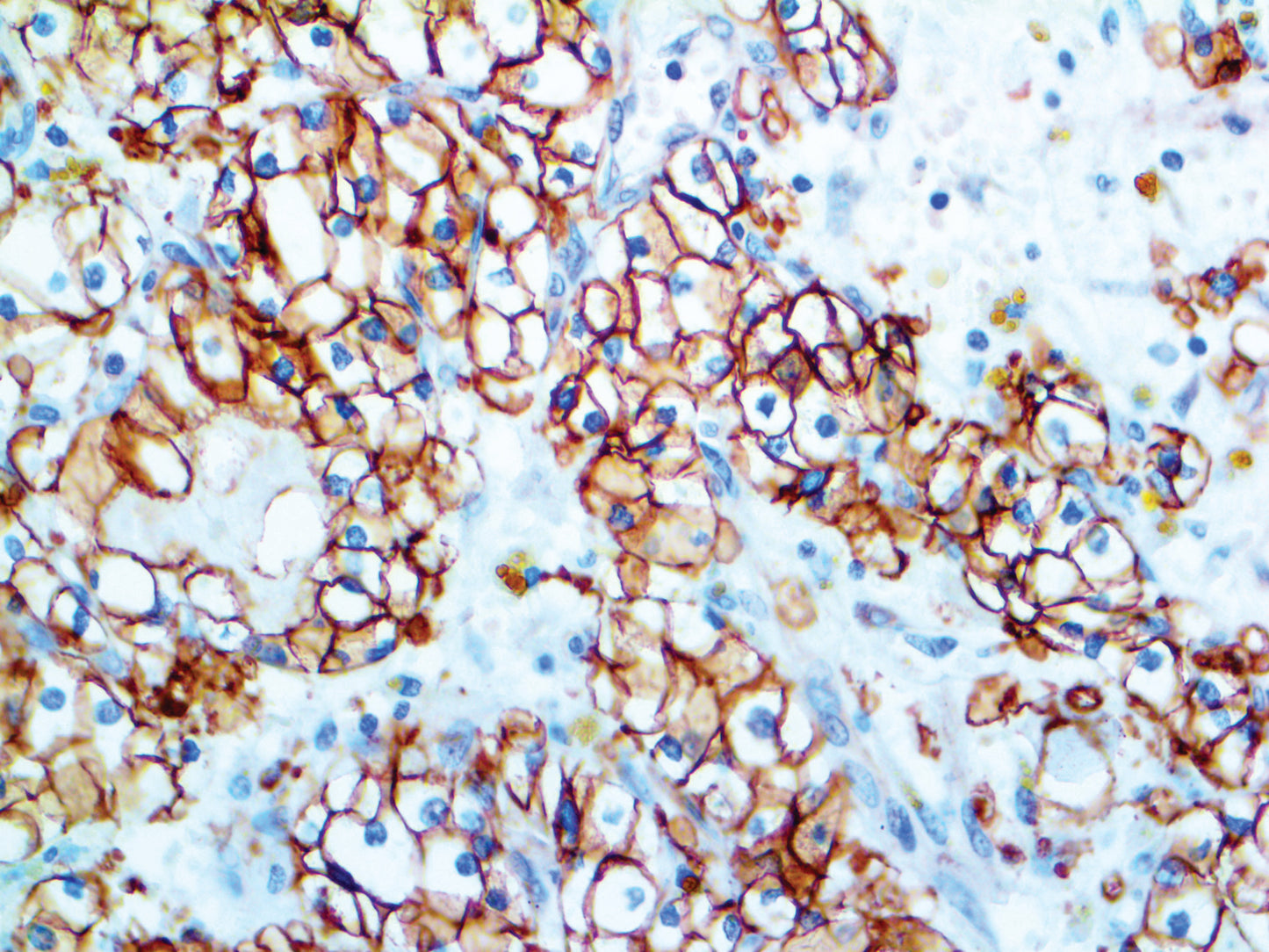
{"type":"root","children":[{"type":"paragraph","children":[{"type":"text","value":"Carbonic anhydrases (CAs) are a large family of zinc metalloenzymes that catalyze the reversible hydration of carbon dioxide. They participate in a variety of biological processes, including respiration, calcification, acid-base balance, bone resorption, and the formation of aqueous humor, cerebrospinal fluid, saliva, and gastric acid. They show extensive diversity in tissue distribution and in their subcellular localization."}]},{"type":"paragraph","children":[{"type":"text","value":"CA9 is a transmembrane protein and the only tumor-associated CA isoenzyme known. It is expressed in all clear-cell renal cell carcinoma, but is not detected in normal kidney or most other normal tissues. It may be involved in cell proliferation and transformation. CA9 is considered to be one of the best cellular biomarkers of hypoxic regions in many solid tumors."}]}]}
Antibody Type
Rabbit Monoclonal
Clone
EP161
Isotype
IgG
Localization
Cytoplasmic, Membranous
Dilution
1:25-1:100
Species Reactivity
Human
Immunogen
Synthetic peptide corresponding to residues in the extracellular domain of the human Carbonic Anhydrase 9 protein