 US & Canada:
  Email:


 Access IFU & SDS
Summary & Explanation
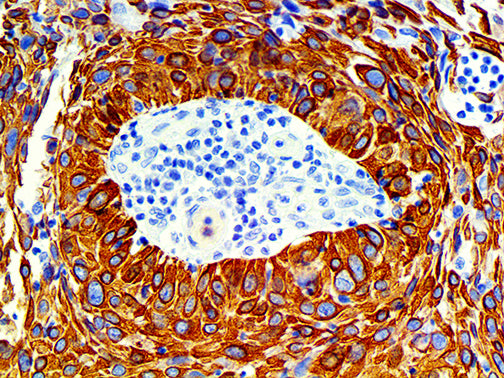
{"type":"root","children":[{"type":"paragraph","children":[{"type":"text","value":"Cytokeratin 14 is a Type I polypeptide found in basal cells of squamous epithelia, some glandular epithelia, myoepithelium, and mesothelial cells. It is usually found as a heterotetramer with two cytokeratin 5 molecules, and a Type II keratin. Together, they form the cytoskeleton of epithelial cells. Mutations in the genes for these cytokeratins are associated with Epidermolysis Bullosa Simplex."}]},{"type":"paragraph","children":[{"type":"text","value":"Cytokeratin 14 has been studied as a prognostic marker in Breast Cancer. This antibody labels the basal layer of stratifying squamous and non-squamous epithelia. The staining pattern is cytoplasmic. It recognizes Basal Cell Carcinomas and Squamous Cell Carcinomas. Anti-CK14 has been demonstrated to be useful in differentiating Squamous Cell Carcinomas from other epithelial tumors. This antibody has also been useful in separating oncocytic tumors of the kidney from renal mimics, as well as in determining metaplastic Carcinomas of the Breast."}]}]}
Antibody Type
Mouse Monoclonal
Clone
LL002
Isotype
IgG3
Localization
Cytoplasmic
Dilution
1:50-1:200
Species Reactivity
Human, Rat
Immunogen
Synthetic peptide of 15 amino acid residues from the C-terminus of the human cytokeratin 14.