 US & Canada:
  Email:


 Access IFU & SDS
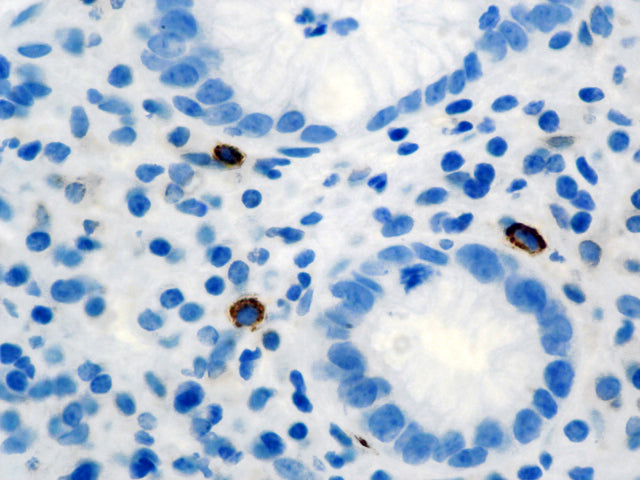
Summary & Explanation
{"type":"root","children":[{"type":"paragraph","children":[{"type":"text","value":"Tryptase is the most abundant secretory granule-derived serine proteinase contained in mast cells and has recently been used as a marker for mast cell activation. It is involved in allergenic response and is suspected to act as a mitogen for fibroblast lines. Elevated levels of serum tryptase occur in both anaphylactic and\n anaphylactoid reactions, but a negative test does not exclude anaphylaxis. Mast cells contain a number of preformed chemical mediators such as histamine, chymase, carboxypeptidase and proteolytic tryptase."}]},{"type":"paragraph","children":[{"type":"text","value":"Human mast cell tryptase is considered to be an important marker of mast cell activation as well as an important mediator of inflammation. Anti-tryptase is a good marker for mast cells, basophils, and their derivatives."}]}]}
Antibody Type
Mouse Monoclonal
Clone
G3
Isotype
IgG1
Localization
CytoPlasmic
Dilution
1:100-1:500
Species Reactivity
Human
Immunogen
Purified human tryptase protein.