 US & Canada:
  Email:


 Access IFU & SDS
Summary & Explanation
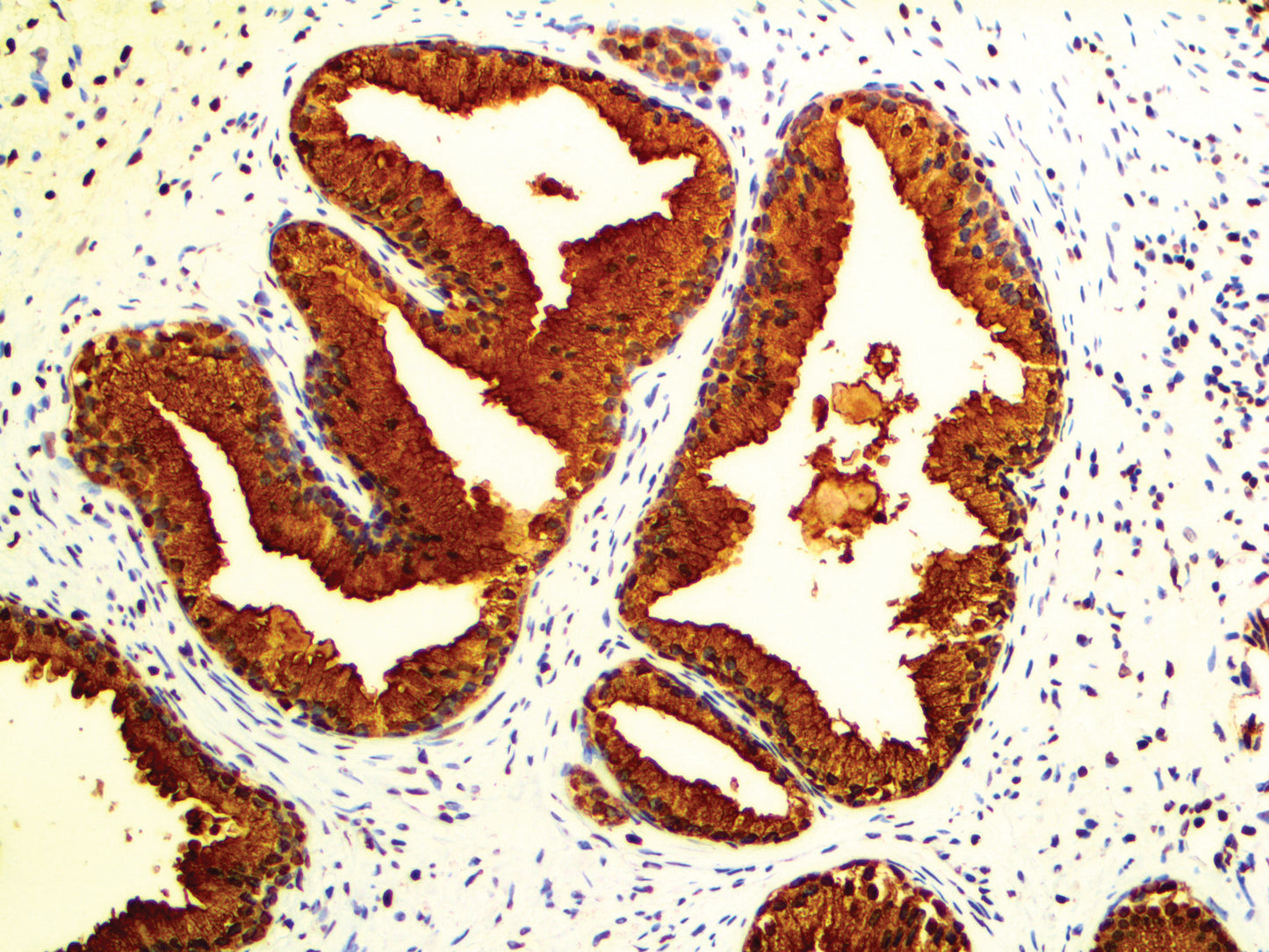
{"type":"root","children":[{"type":"paragraph","children":[{"type":"text","value":"Prostatic specific acid phosphatase (PSAP) is an enzyme produced by the prostate. It may be found in increased amounts in men who have prostate cancer or other diseases. The highest levels of acid phosphatase are found in metastasized prostate cancer. Diseases of the bone, such as Paget’s disease or hyperparathyroidism,\n diseases of blood cells (such as Sickle-Cell Disease), Multiple Myeloma or Lysosomal Storage Diseases (such as Gaucher’s disease), will show moderately increased levels. Certain medications can cause temporary increases or decreases in acid phosphatase levels. Manipulation of the prostate gland through massage, biopsy or rectal exam before a test may increase the levels of PSAP."}]},{"type":"paragraph","children":[{"type":"text","value":"This antibody reacts with prostatic specific acid phosphatase in the glandular epithelium of the normal and Hyperplastic Prostate, Carcinoma of the prostate and metastatic cells of Prostatic Carcinoma. This marker may be helpful in pinpointing the site of origin in cases of Metastatic Carcinoma of the prostate, and is considered a more sensitive marker than PSA. However, it also offers less specificity."}]}]}
Antibody Type
Mouse Monoclonal
Clone
PASE\4LJ
Isotype
IgG1
Localization
Cytoplasmic
Dilution
1:250-1:1000
Species Reactivity
Human
Immunogen
Purified prostatic acid phosphatase from human seminal plasma.