 US & Canada:
  Email:


 Access IFU & SDS
Summary & Explanation
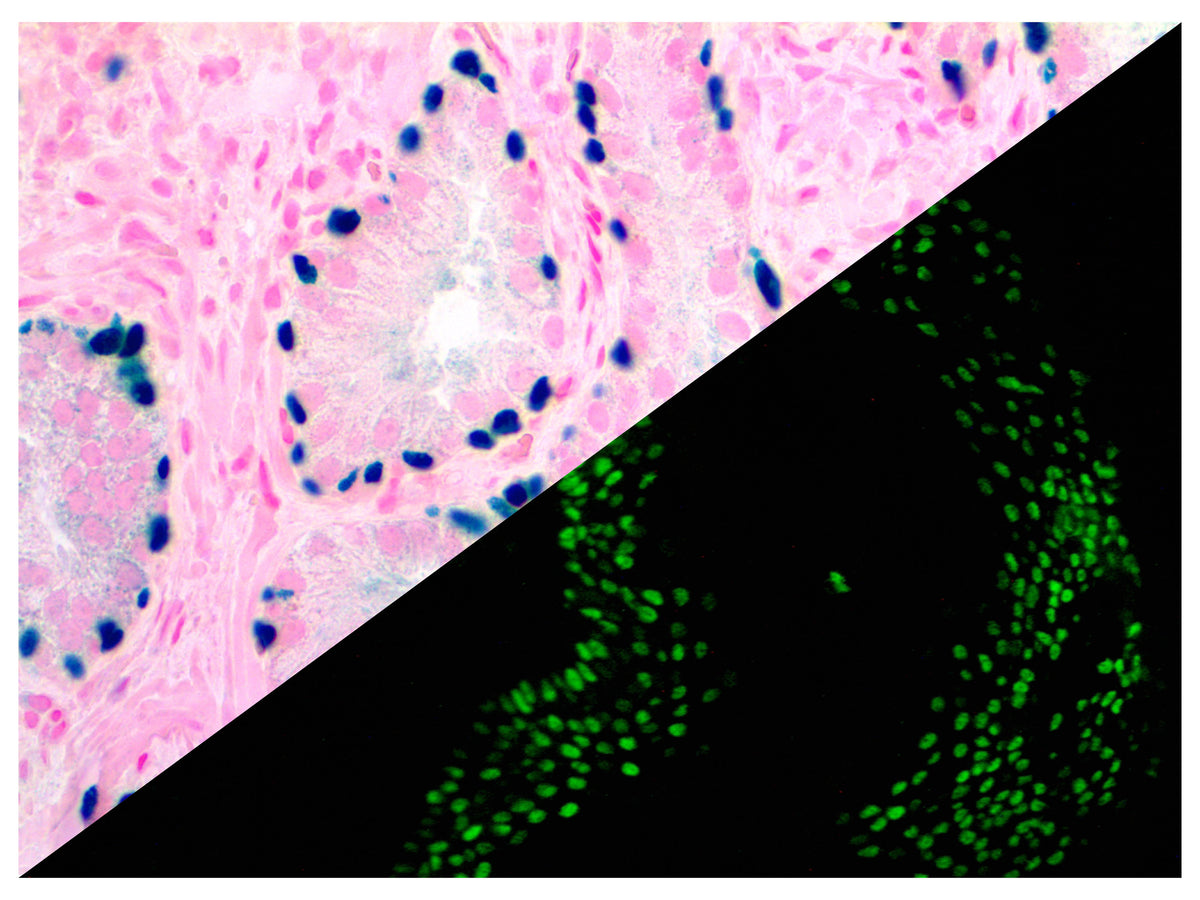
{"type":"root","children":[{"type":"paragraph","children":[{"type":"text","value":"In addition to p53, mammalian cells contain two homologous genes, p63 and p73. These genes give rise to the expression of proteins that are highly similar to p53 in structure and function. In particular, p63 and p73 proteins can induce p53-responsive genes and elicit programmed cell death. p73 and p63 are more important during development and differentiation. In particular, p63 appears to be primarily implicated in epithelial development. Anti-p63 to human p63 protein labels an epitope common to all six p63 isotypes (TAp63α, TAp63β, TAp63γ, ΔNp63α, ΔNp63β, ΔNp63γ). p63 labels the nuclei of myoepithelial cells in the prostate gland as well as breast tissue, making it useful in differentiating benign vs. malignant prostate lesions and breast lesions."}]}]}
Antibody Type
Rabbit Monoclonal
Clone
EP174
Isotype
IgG
Localization
Nuclear
Dilution
1:50 - 1:200
Species Reactivity
Human, Predicted: Mouse, Rat, Rabbit
Immunogen
Recombinant protein fragment corresponding to amino acids 1-203 of human p63 protein.