 US & Canada:
  Email:


 Access IFU & SDS
Summary & Explanation
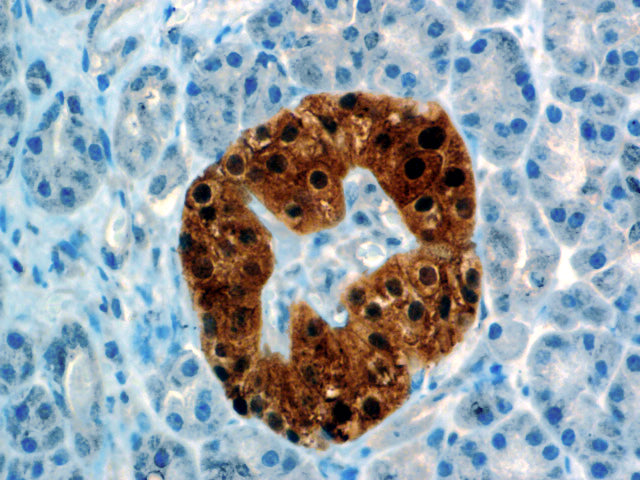
{"type":"root","children":[{"type":"paragraph","children":[{"type":"text","value":"Neuron-Specific Enolase (NSE, Enolase 2) is a human gene. It makes a phosphopyruvate hydratase. This gene encodes one of the three enolase isoenzymes found in mammals. This isoenzyme, a homodimer, is found in mature neurons and cells of neuronal origin. A switch from alpha enolase to gamma enolase occurs in neural tissue during development in rats and primates. NSE is present in high concentration in neurons and in central and peripheral neuroendocrine cells; therefore, NSE reacts with cells of neural and neuroendocrine lineage. If neoplastic cells coexpress keratins and NSE, neuroendocrine differentiation is probable. However, neural tumors that do not express keratin, and show no staining with NSE, would not exclude neural or neuroendocrine differentiation. Thus, detection of neural and neuroendocrine lineage requires the use of panels which include NSE and other markers such as keratin, chromogranin, synaptophysin and neurofilament."}]}]}
Antibody Type
Mouse Monoclonal
Clone
BSB-94
Isotype
IgG1/K
Localization
Cytoplasmic
Dilution
1:250-1:1000
Species Reactivity
Human
Immunogen
Purified human neuron-specific enolase (NSE).