 US & Canada:
  Email:


 Access IFU & SDS
Summary & Explanation
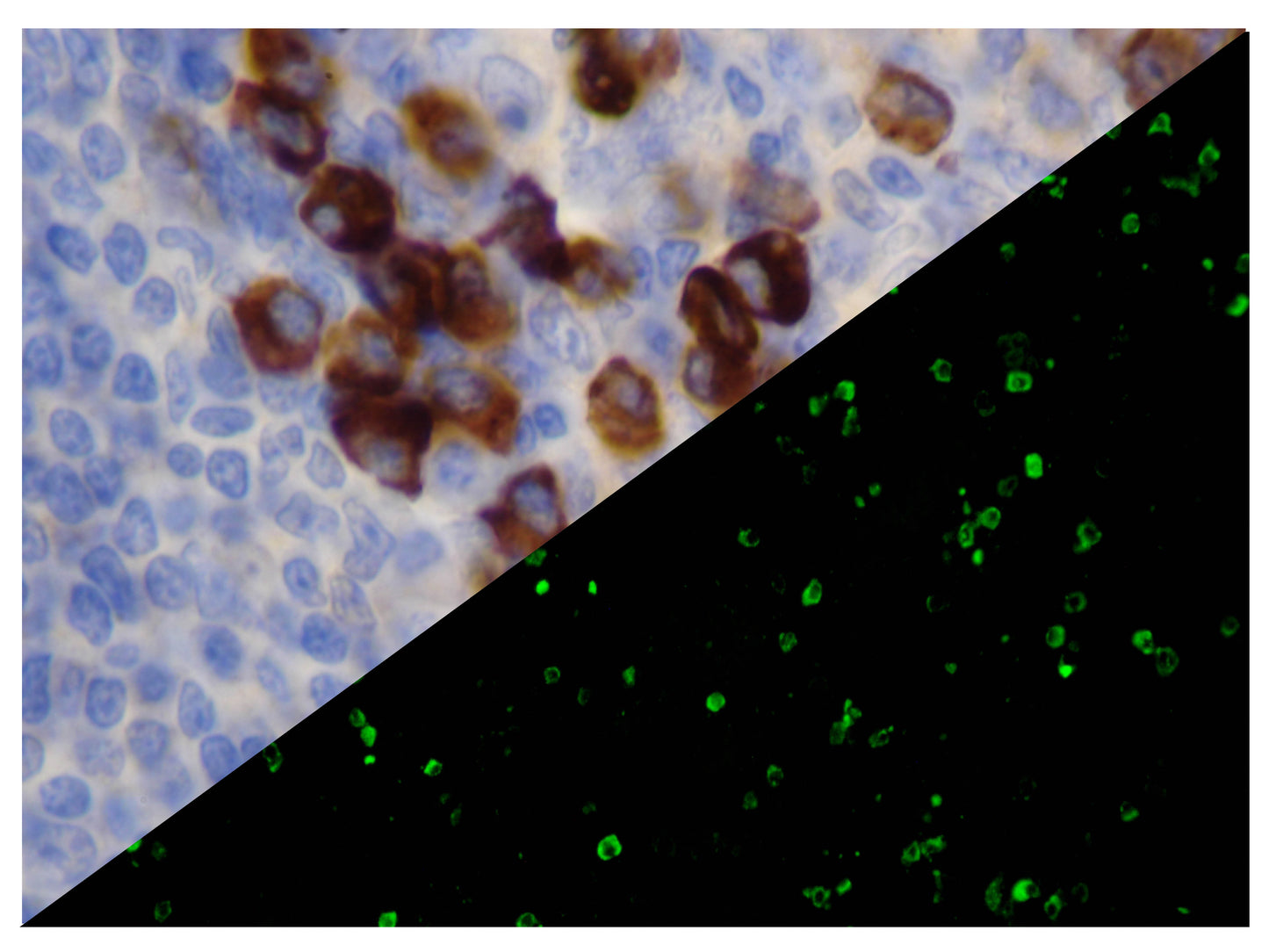
{"type":"root","children":[{"type":"paragraph","children":[{"type":"text","value":"Kappa detects surface immunoglobulin on normal and neoplastic B-cells. In paraffin-embedded tissue, Kappa exhibits strong staining of kappa-positive plasma cells and cells that have absorbed exogenous immunoglobulin."}]},{"type":"paragraph","children":[{"type":"text","value":"When studying B-cell neoplasms, the determination of light-chain ratios remains the centerpiece. This is sound reasoning because most B-cell Lymphomas express either kappa or lambda light chains, whereas reactive proliferations display a mixture of kappa and lambda-positive cells. If only a single light-chain type is detected, a lympho-proliferative disorder is very likely. Monoclonality is determined by a kappa-lambda ratio greater than or equal to 3:1, a lambda-kappa ratio greater than or equal to 2:1, or a monoclonal population of 75% or more of the total population."}]}]}
Antibody Type
Mouse Monoclonal
Clone
BSB-58
Isotype
IgG1/K
Localization
Cytoplasmic
Dilution
1:250-1:1000
Species Reactivity
Human, Dog, Cat
Immunogen
Purified Kappa Light chains from human myeloma serum.