 US & Canada:
  Email:


 Access IFU & SDS
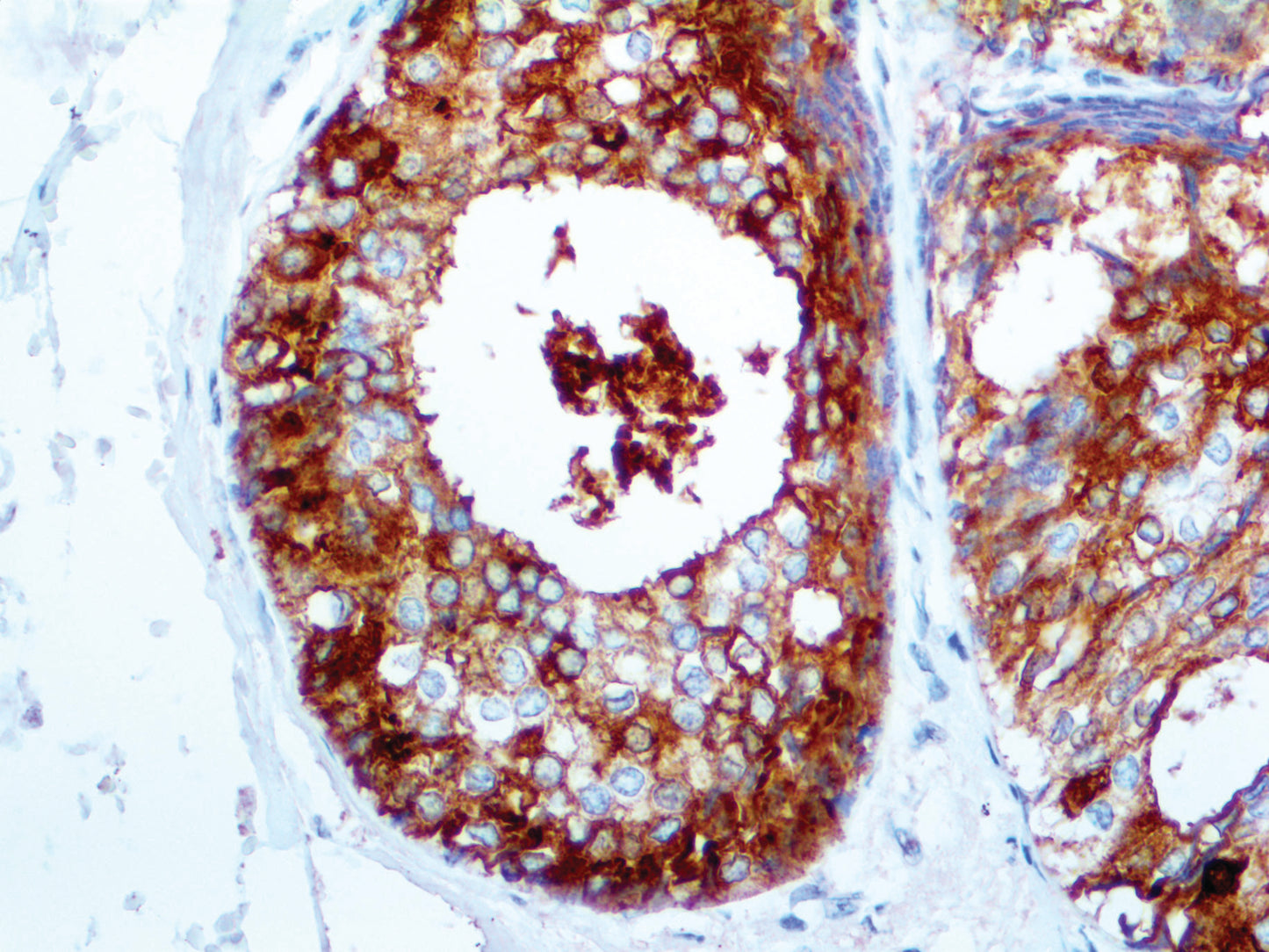
Summary & Explanation
{"type":"root","children":[{"type":"paragraph","children":[{"type":"text","value":"Gross Cystic Disease is a common premenopausal disorder in which gross cysts are the predominant pathologic lesion. It is characterized by production of a fluid secretion which accumulates in the breast cysts. Gross Cystic Disease fluid is a pathologic secretion from breast composed of several glycoproteins, including a unique 15 kDa monomer protein, GCDFP-15. The cells within the body that produce GCDFP-15 appear to be restricted primarily to those with apocrine function such as breast cysts and in apocrine glands in the axilla, vulva, eyelid, and ear canal."}]},{"type":"paragraph","children":[{"type":"text","value":"Studies have found GCDFP-15 to be a highly specific and sensitive marker for breast cancer. Approximately 70% of breast carcinomas stain positive with antibody to GCDFP-15. In contrast, Colorectal Carcinomas, as well as Mesotheliomas, do not stain with this antibody. Lung Adenocarcinomas rarely stain with this antibody."}]}]}
Antibody Type
Mouse Monoclonal
Clone
23A3
Isotype
IgG2a
Localization
Cytoplasmic
Dilution
1:100-1:500
Species Reactivity
Human, Rat
Immunogen
Recombinant protein encoding the excreted domain of human GCDFP15.