 US & Canada:
  Email:


 Access IFU & SDS
Summary & Explanation
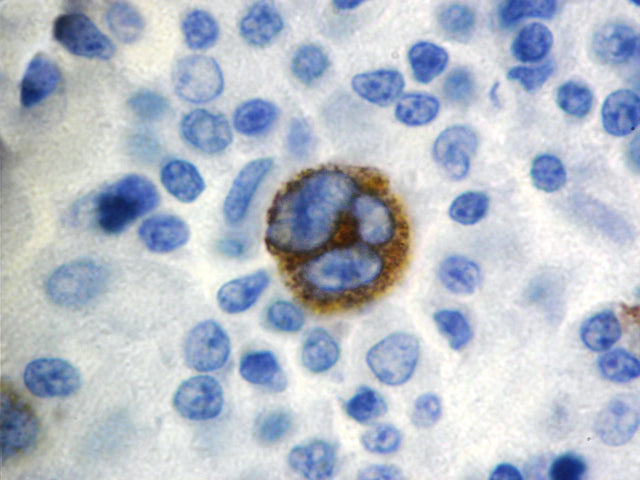
{"type":"root","children":[{"type":"paragraph","children":[{"type":"text","value":"The Epstein-Barr virus (EBV), also called Human Herpesvirus 4 (HHV-4), is a virus of the Herpes family, and is one of the most common viruses in humans. The virus can execute many distinct programs of gene expression, which can be broadly categorized as being lytic cycle or latent cycle. The lytic cycle, or productive infection, results in staged expression of several viral proteins with the ultimate objective of producing infectious virions. The latent cycle (lysogenic) programs are those that do not result in production of virions. A very limited, distinct set of viral proteins are produced during latent cycle infection. These include Epstein Barr nuclear antigens EBNA-1, EBNA-2, EBNA-3A, EBNA-3B, EBNA-3C, EBNA-leader protein (EBNA-LP), latent membrane proteins LMP-1, LMP-2A and LMP-2B and the Epstein-Barr encoded RNAs (EBERs). In addition, EBV codes for at least twenty microRNAs which are expressed in latently infected cells."}]}]}
Antibody Type
Mouse Monoclonal
Clone
CS1-4
Isotype
IgG1
Localization
Cytoplasmic
Dilution
1:25-1:100
Species Reactivity
Human
Immunogen
Recombinant fusion protein of bacterial beta-galactosidase and EBV LMP-1.