 US & Canada:
  Email:


 Access IFU & SDS
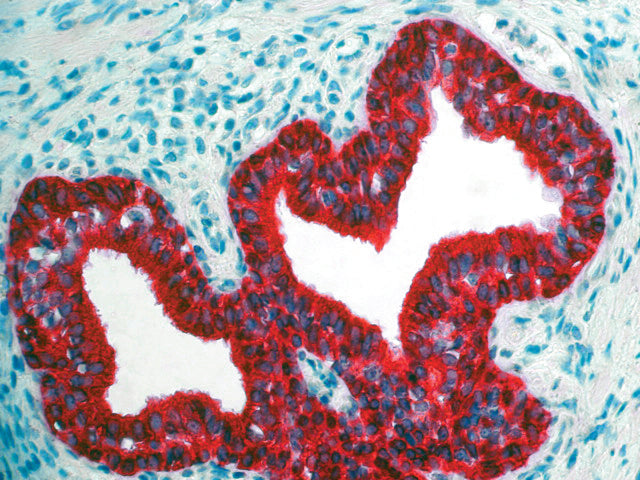
Summary & Explanation
{"type":"root","children":[{"type":"paragraph","children":[{"type":"text","value":"Cytokeratin 8 belongs to the Type II (basic) subfamily of high molecular-weight keratins and exists in combination with cytokeratin 18. Cytokeratin 8 is primarily found in the non-squamous epithelia and is present in the majority of Adenocarcinomas and Ductal Carcinomas. It is absent in Squamous Cell Carcinomas. Hepatocellular Carcinomas are defined by the use of antibodies that recognize only cytokeratin polypeptides 8 and 18."}]},{"type":"paragraph","children":[{"type":"text","value":"Anti-Cytokeratin 8/35βH11 stains most Non-Squamous Epithelial tumors; Squamous tumors are negative for this antibody as a rule. This antibody stains Adenocarcinomas of the breast, ovary, gastrointestinal tract, thyroid, pancreas, bile duct, and salivary glands. This antibody does not react with skeletal muscle or nerve cells."}]}]}
Antibody Type
Mouse Monoclonal
Clone
35BetaH11
Isotype
IgM
Localization
Cytoplasmic
Dilution
1:50-1:200
Species Reactivity
Human
Immunogen
Triton/High salt-insoluble material from the human hepatocellular carcinoma cell line Hep3B.