 US & Canada:
  Email:


 Access IFU & SDS
Summary & Explanation
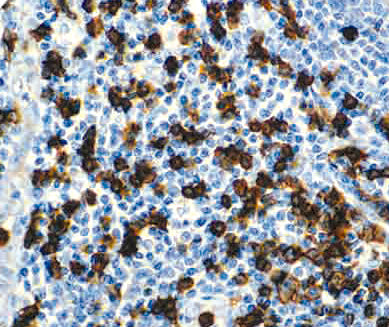
{"type":"root","children":[{"type":"paragraph","children":[{"type":"text","value":"CD8 is a transmembrane glycoprotein that serves as a co-receptor for the T-cell receptor (TCR). Like the TCR, CD8 binds to a major histocompatibility complex (MHC) molecule that is specific for the Class I MHC protein. To function, CD8 forms a dimer, consisting of a pair of CD8 chains. The most common form of CD8 is composed of a CD8-α and CD8-β chain, both members of the immunoglobulin superfamily with an\n immunoglobulin variable (IgV)-like extracellular domain connected to the membrane by a thin stalk, and an intracellular tail."}]},{"type":"paragraph","children":[{"type":"text","value":"CD8 is a T-cell marker for the detection of cytotoxic/suppressor cells of blood lymphocytes. CD8 is also detected on NK cells, most thymocytes, a subpopulation of null cells and bone marrow cells. This antibody is used to distinguish between reactive and neoplastic T-cells."}]}]}
Antibody Type
Mouse Monoclonal
Clone
C8\144B
Isotype
IgG/K
Localization
Membranous
Dilution
1:250-1:1000
Species Reactivity
Human
Immunogen
A 13 amino acid synthetic peptide from the C-terminal cytoplasmic domain of alpha chain of human CD8 molecule.