 US & Canada:
  Email:


 Access IFU & SDS
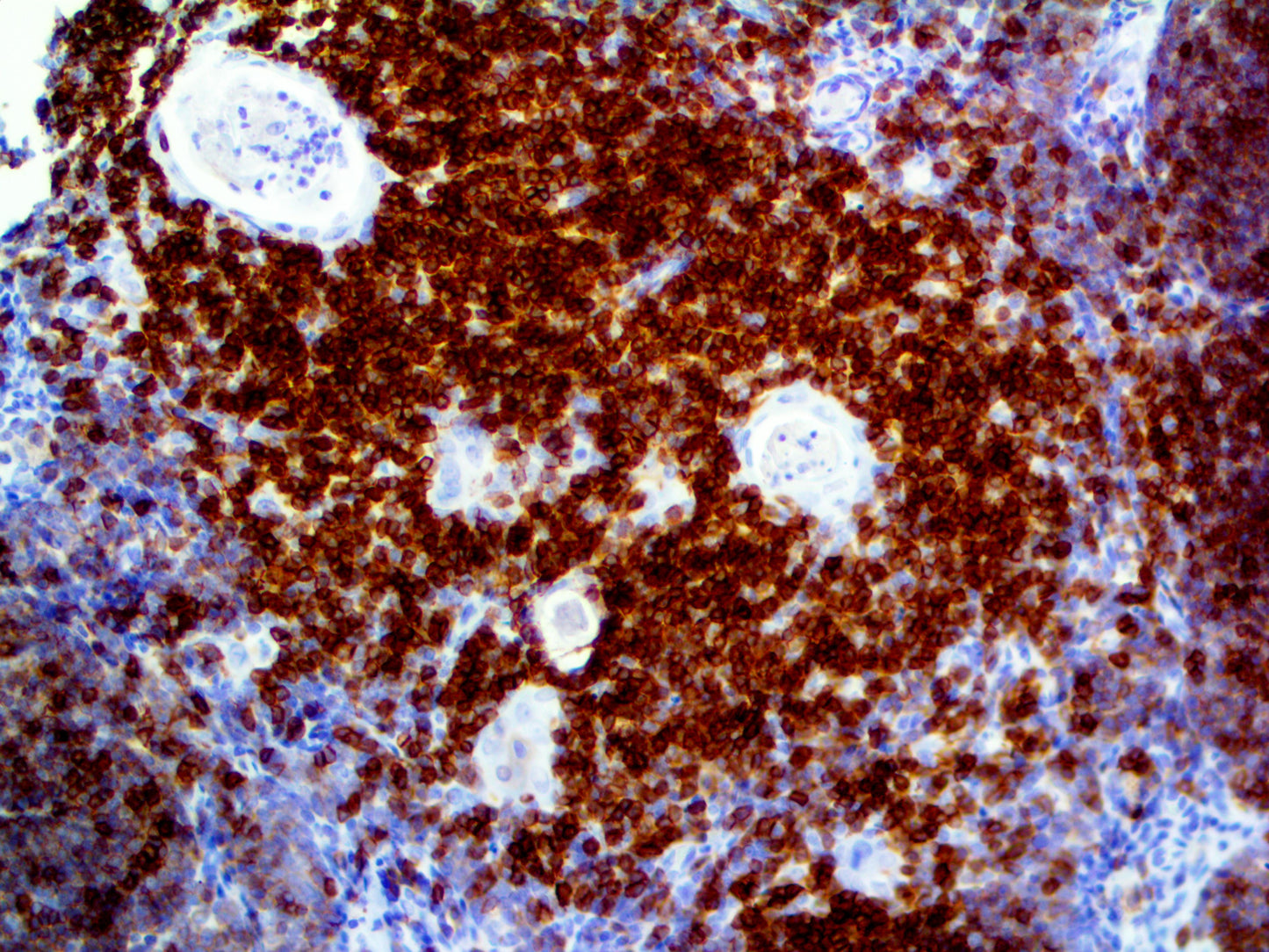
Summary & Explanation
{"type":"root","children":[{"type":"paragraph","children":[{"type":"text","value":"CD5 is a glycoprotein monomer with an MW of 67 kDa belonging to the scavenger receptor cysteine-rich (SRCR) family of extracellular domain-like structures. It possesses a large cytoplasmic domain suitable for signal transduction."}]},{"type":"paragraph","children":[{"type":"text","value":"CD5 is a T-cell marker that also reacts with a range of neoplastic B-cells, e.g., B-cell Chronic Lymphocytic Leukemia (B-CLL), B-cell Small Lymphocytic Lymphoma (B-SLL), and Mantle Cell Lymphoma. CD5 is expressed in T-lymphocyte subsets and is modulated during cellular activation; however, it does not react with granulocytes or monocytes."}]}]}
Antibody Type
Rabbit Monoclonal
Clone
RBT-CD5
Isotype
IgG
Localization
Membranous
Dilution
1:25-1:100
Species Reactivity
Human
Immunogen
Synthetic peptide corresponding to residues from the intercellular region of the human CD5 protein.