 US & Canada:
  Email:


 Access IFU & SDS
Summary & Explanation
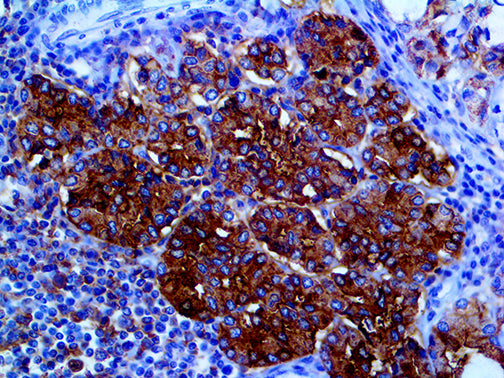
{"type":"root","children":[{"type":"paragraph","children":[{"type":"text","value":"CA19-9 (carbohydrate antigen 19-9 or sialylated Lewis (a) antigen) is a blood test from the tumor marker category. It was discovered in patients with Colon Cancer and Pancreatic Cancer in 1981. Increased levels of CA19-9 are also found in non-malignant conditions, such as Mirizzi’s Syndrome and diseases of the bile duct\n and liver. The main use of CA19-9 is to determine whether a pancreatic tumor is secreting it; if that is the case, then the levels should fall when the tumor is treated, and they may rise again if the disease recurs."}]},{"type":"paragraph","children":[{"type":"text","value":"CA19-9 antigen is highly expressed in Gastrointestinal (gastric, pancreatic, and colonic) Adenocarcinomas and salivary gland Mucoepidermoid Carcinomas. CA19-9 is usually not reactive with breast, kidney, and prostate Carcinomas, but is reactive with sialylated Lea-active pentasaccharide (sialylated lacto-N-fucopentaose II), which is enzymatically synthesized by sialylation of Type 1 carbohydrate chains."}]}]}
Antibody Type
Mouse Monoclonal
Clone
121SLE
Isotype
IgM
Localization
Cytoplasmic
Dilution
1:100-1:500
Species Reactivity
Human
Immunogen
Purified mucins from ovarian cyst.