 US & Canada:
  Email:


 Access IFU & SDS
Summary & Explanation
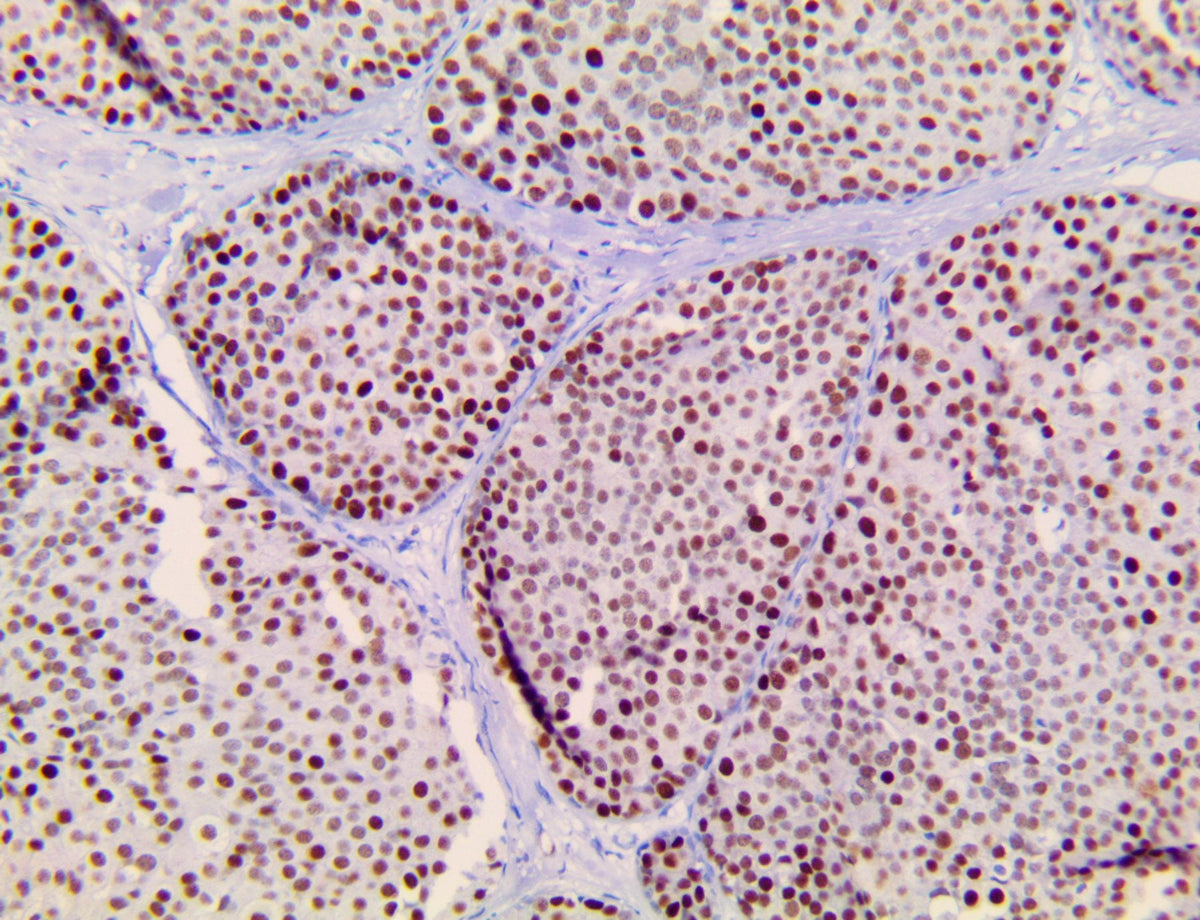
{"type":"root","children":[{"type":"paragraph","children":[{"type":"text","value":"The trichorhinophalangeal syndrome 1 (TRPS-1) gene belongs to the GATA transcription factor family. TRPS-1 has been identified as a highly prevalent gene in Breast Cancer, expressed in >90% of estrogen receptor alpha (ERα)+ and ERα− BC subtypes."},{"type":"text","value":" As of today, the GATA3 tumor marker is commonly used to determine the breast origin for ER-positive and low-grade Breast Cancer, but is low in sensitivity <20% in metaplastic Breast Carcinoma such as Triple-Negative Breast Cancer (TNBC). In contrast, TRPS1 and GATA3 had comparable positive expression in ER-positive (98% vs. 95%) and HER2-positive (87% vs. 88%) Breast Carcinomas, but TRPS1 had higher expression than GATA3 in metaplastic (86% vs. 21%) and nonmetaplastic (86% vs. 51%) TNBC cases."},{"type":"text","value":" TCGA data indicated that the (TRPS1) is a specific gene for Breast Carcinoma across 31 solid tumor types, including all 4 subtypes of Breast Carcinoma such as ER/PR-positive luminal A and B types, HER2-positive type, and basal-type/TNBC. TRPS1 produced no or little expression in Lung, Pancreatic, Colon, or Gastric Adenocarcinomas, Urothelial, Renal, or Ovarian Carcinomas, or Melanoma; it can be concluded that the TRPS1 marker is a sensitive and specific marker for Breast Cancer and particularly for TNBC."}]}]}
Antibody Type
Rabbit Monoclonal
Clone
EP392
Reactivity
Paraffin, Frozen
Control
Triple Negative Breast Carcinoma, Ductal Breast Carcinoma, Fallopian Tubes, Breast
Isotype
IgG
Localization
Nuclear
Dilution
Species Reactivity
Human
Immunogen
Synthetic peptide corresponding to residues of human TRPS1 protein.