 US & Canada:
  Email:


 Access IFU & SDS
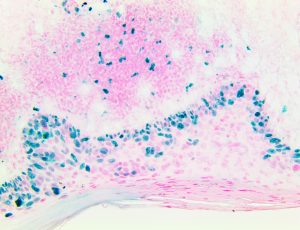
Summary & Explanation
{"type":"root","children":[{"type":"paragraph","children":[{"type":"text","value":"The Ki-67 protein is a cellular marker for proliferation. It is strictly associated with cell proliferation. During the interphase, the Ki-67 antigen can be exclusively detected within the cell nucleus, whereas in mitosis most of the protein is relocated to the surface of the chromosomes. Ki-67 protein is present during all active phases of the cell cycle (G1, S, G2, and mitosis), but is absent from resting cells (G0)."}]},{"type":"paragraph","children":[{"type":"text","value":"Ki-67 is an excellent marker to determine the growth fraction of a given cell population. The fraction of Ki-67-positive tumor cells (the Ki-67 labeling index) is often correlated with the clinical course of cancer. The best-studied examples in this context are carcinomas of the prostate and the breast."}]}]}
Antibody Type
Rabbit Monoclonal
Clone
RM360
Isotype
IgG
Localization
Nuclear
Species Reactivity
Human
Immunogen
A peptide corresponding to the internal region of human Ki67.