 US & Canada:
  Email:


 Access IFU & SDS
Summary & Explanation
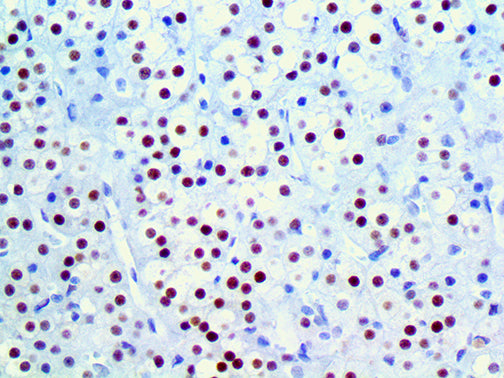
{"type":"root","children":[{"type":"paragraph","children":[{"type":"text","value":"Transcription factor E3 is a protein that in humans is encoded by the TFE3 gene. TFE3, a member of the helix-loop-helix family of transcription factors, binds to the mu-E3 motif of the immunoglobulin heavy-chain enhancer and is expressed in many cell types. A proportion of renal cell carcinomas (RCC) that occur in young patients are associated with translocations involving the TFE3 gene, which results in gene fusions. Subsets of papillary renal cell carcinomas, a t(X;1)(p11;q21) chromosome translocation has been repeatedly reported and is thought to be the cause of this cancer. As a result of the translocation, the transcription factor TFE3 on the X chromosome becomes fused to this gene on chromosome 1. The fused gene results in the fusion of N-terminal proline-rich region of the protein encoded by this gene to the entire TFE3 protein. \n The Xp11.2 translocation represents the most common type of RCC in children but is less frequent on a percentage basis in adults. Morphologically, these cancers frequently show papillary architecture and clear cytoplasm, frequently have associated psammoma bodies and under-express epithelial markers such anti-cytokeratin and anti-EMA compared with typical adult type RCC. TFE3 is the most sensitive and specific immunohistochemical marker for the RCC Xp11.2 translocation, which reflects over-expression of the resulting fusion proteins relative to native TFE3. The Xp11.2 renal cell carcinoma has been recently established as a tumor affecting 15% of RCC patients <45 years. Many patients present with advanced stage with frequent lymph node metastases. Histologically, Xp11.2 RCC is characterized by mixed papillary nested/alveolar growth pattern and tumor cells with clear and/or eosinophilic, voluminous cytoplasm. Neoplastic cells show intense nuclear immunoreactivity to TFE3, while focal immunostaining for melanocytic markers, including MART-1/ Melan A in some cases, are also noted. The behavior of Xp11.2 RCC in children and young adults is considered as indolent even when diagnosed at advanced stage, including lymph node metastasis. However, Xp11.2 RCC in older patients behaves in a more aggressive fashion. Therapy includes nephrectomy with extended lymphadenectomy. Alveolar soft part sarcoma (ASPS) is a malignancy with low incidence, but with poor prognosis if misdiagnosed. Immunohistochemical assay using TFE3 antibody has been shown to be a sensitive technique for ASPS diagnosis."}]}]}
Antibody Type
Rabbit Monoclonal
Clone
EP285
Isotype
IgG
Localization
Nuclear
Dilution
1:50-1:200
Species Reactivity
Human
Immunogen
A synthetic peptide corresponding to residues of human TFE3 protein.