 US & Canada:
  Email:


 Access IFU & SDS
Summary & Explanation
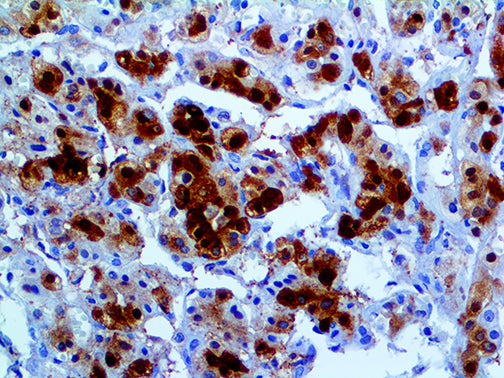
{"type":"root","children":[{"type":"paragraph","children":[{"type":"text","value":"Glutamine synthetase (GS) is an enzyme that plays an essential role in the metabolism of nitrogen by catalyzing the condensation of glutamate and ammonia to form glutamine. GS is present predominantly in the brain, kidneys, and liver. GS in the brain participates in the metabolic regulation of glutamate, the detoxification of brain ammonia, the assimilation of ammonia, recyclization of neurotransmitters, and termination of neurotransmitter signals. In normal liver, GS expression is seen in pericentral hepatocytes, but not in mid-zonal or periportal hepatocytes."}]},{"type":"paragraph","children":[{"type":"text","value":"GS positive tumor cells are believed to be derived from GS positive hepatocytes. GS immunoreactivity has been seen in a majority of hepatocellular carcinoma (HCC), including cases of early HCC (70%) and for low grade HCC (59%).In nonmalignant nodules, GS overexpression is only seen in high grade dysplastic nodules (HGDN, 13.6%). In these cases, GS overexpression was restricted to 11.5%-50% of hepatocytes, whereas in HCC the majority of cases (53%), including early HCC (60%), showed diffuse immunostaining (>50% tumor cells). A panel composed of antibodies against HSP70, GPC3, and GS has been proposed to be very useful in distinguishing between dysplastic and early malignant hepatocellular nodules arising in cirrhosis. Staining of hepatocellular lesions with anti-GS antibody have been useful in the differential diagnosis of focal nodular hyperplasia (FNH), hepatic adenoma (HCA), and dysplastic nodules, and low grade hepatocellular carcinoma. In the case of FNH, GS stains in a characteristic “map-like†pattern, thus differentiating it from HCA, in which GS staining is usually absent, but may occasionally be present at the border of the lesion or around the veins inside the tumor."}]}]}
Antibody Type
Mouse Monoclonal
Clone
GS-6
Isotype
IgG2a
Localization
Cytoplasmic
Dilution
1:50-1:200
Species Reactivity
Human, Predicted Mouse and Rat
Immunogen
Human Glutamine Synthetase aa. 1-373.