 US & Canada:
  Email:


 Access IFU & SDS
Summary & Explanation
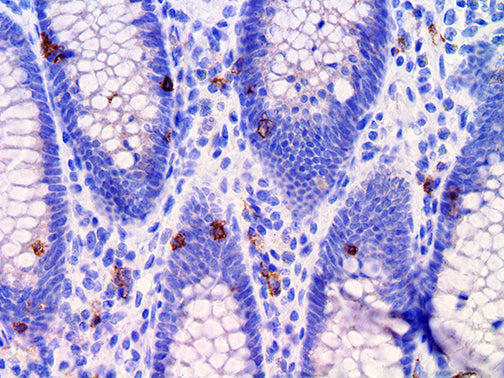
{"type":"root","children":[{"type":"paragraph","children":[{"type":"text","value":"Integrin, alpha E (ITGAE), also known as CD103, is an integrin protein that in human is encoded by the ITGAE gene. CD103 binds integrin beta 7 (β7– ITGB7) to form the complete heterodimeric integrin molecule αEβ7. CD103 is expressed widely on intraepithelial lymphocyte (IEL) T cells (both α β T cells and γ δ T cells) and on some peripheral regulatory T cells (Tregs). It has also been reported on lamina propria T cells. A subset of dendritic cells in the gut mucosa and in mesenteric lymph nodes also expresses this marker and is known as CD103 DCs. The chief ligand for αEβ7 is E-cadherin, an adhesion molecule found on epithelial cells."}]},{"type":"paragraph","children":[{"type":"text","value":"CD103 has been found in mononuclear cells in the interfollicular area of lymph nodes and in intraepithelial cells in the overlying mucosa located primarily toward the basal layer of the tonsil. CD103 is useful in identifying Hairy Cell Leukemia, which is positive for this marker in most cases in contrast to other hematologic malignancies which are negative for CD103, with the exception of Splenic Marginal Zone Lymphoma, which rarely expresses CD103. The high sensitivity of anti-CD103 for Hairy Cell Leukemia makes this marker valuable when distinguishing this malignancy from other B-cell neoplasms."}]}]}
Antibody Type
Rabbit Monoclonal
Clone
EP206
Isotype
IgG
Localization
Cytoplasmic, Membranous
Dilution
1:25-1:100
Species Reactivity
Human
Immunogen
A synthetic peptide corresponding to residues of human CD103 protein.