 US & Canada:
  Email:


 Access IFU & SDS
Summary & Explanation
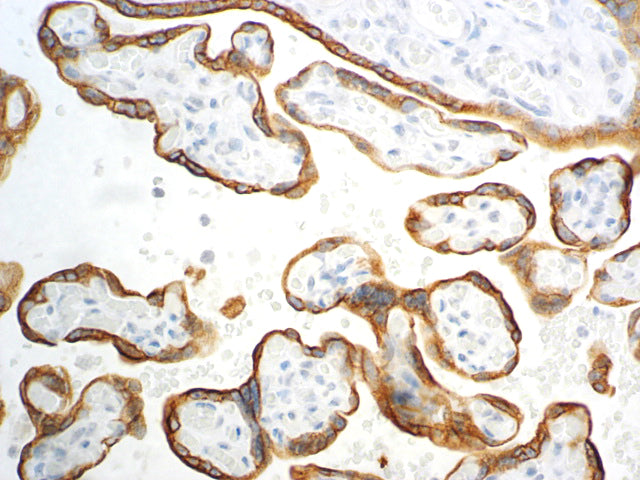
{"type":"root","children":[{"type":"paragraph","children":[{"type":"text","value":"Alkaline phosphatase, placental type also known as placental alkaline phosphatase (PLAP) is an allosteric enzyme that in humans is encoded by the ALPP gene. PLAP is found in trophoblast cells of normal mature human placenta, Seminomas of testis and Ovarian Carcinomas. Detection of alkaline phosphatase in serum is a marker for Ovarian and Testicular Cancer."}]},{"type":"paragraph","children":[{"type":"text","value":"This antibody reacts with a membrane-bound isoenzyme of placental alkaline phosphatase occurring in the placenta during the 3rd trimester of gestation.\n This antibody immunoreacts with Germ Cell Tumors and can discriminate between these and other neoplasms. Somatic neoplasms (e.g., breast, gastrointestinal, prostatic and urinary cancers) may also immunoreact with antibodies to PLAP. PLAP positivity, in conjunction with keratin negativity, favors Seminoma over Carcinoma. Germ Cell Tumors are usually keratin positive but they regularly fail to stain with EMA, whereas most Carcinomas stain with anti-EMA. This antibody has shown cross-reaction with human intestinal alkaline phosphatase."}]}]}
Antibody Type
Mouse Monoclonal
Clone
BSB-47
Isotype
IgG2b/K
Localization
Cytoplasmic
Dilution
1:250-1:1000
Species Reactivity
Human
Immunogen
Synthetic peptive corresponding to the N-terminus of human PLAP protein.