 US & Canada:
  Email:


 Access IFU & SDS
Summary & Explanation
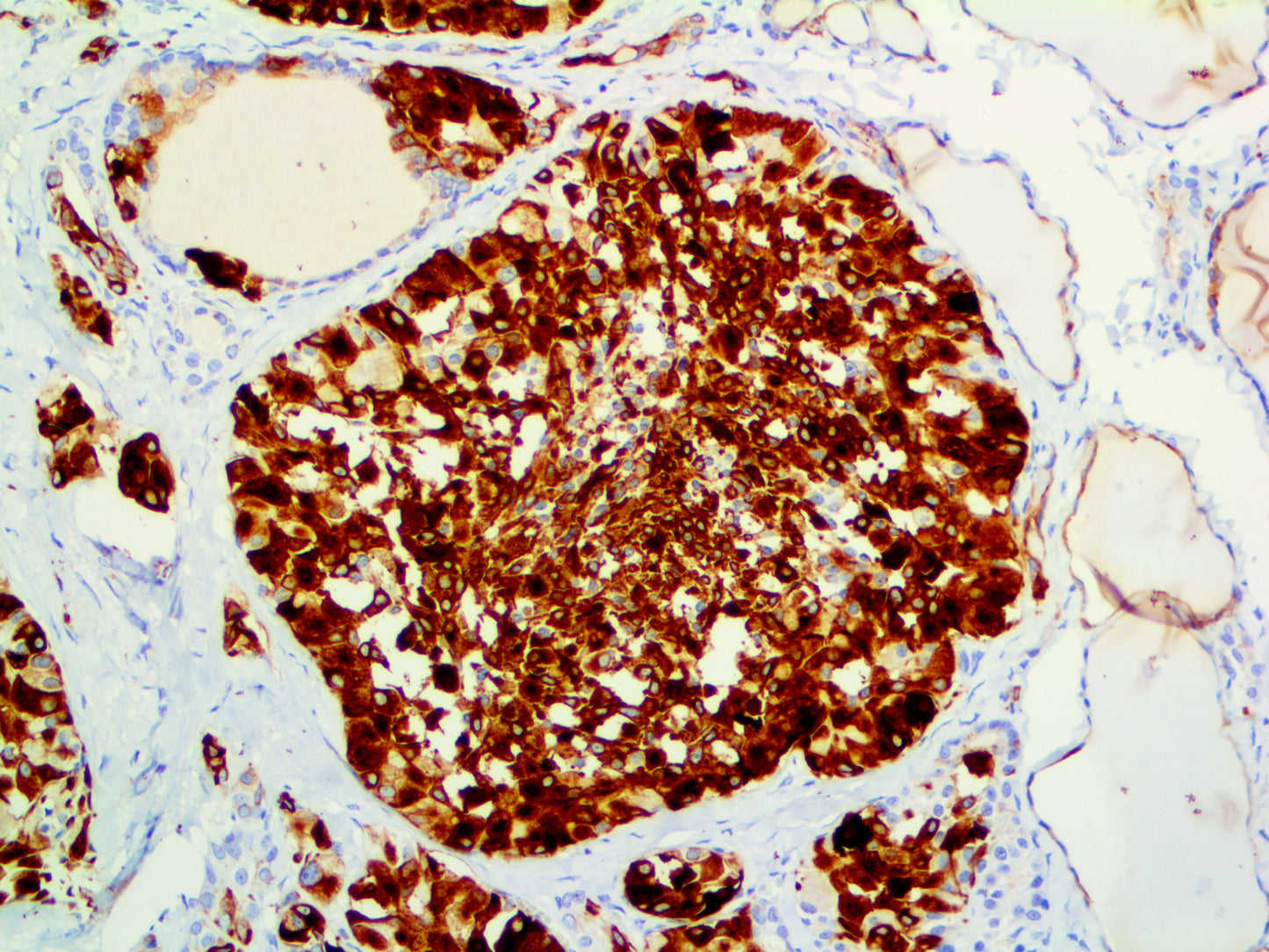
{"type":"root","children":[{"type":"paragraph","children":[{"type":"text","value":"Cytokeratin 19 is a Type I cytokeratin. Unlike its related family members, this smallest-known acidic cytokeratin is not paired with a basic cytokeratin in epithelial cells. It is specifically found in the periderm, the transiently superficial layer that envelops the developing epidermis."}]},{"type":"paragraph","children":[{"type":"text","value":"Anti-Cytokeratin 19 reacts with a wide variety of epithelium and epithelial malignancies including Adenocarcinomas of the colon, stomach, pancreas, biliary tract, liver and breast. Perhaps the most useful application is the identification of Thyroid Carcinoma of the papillary type, although Follicular Carcinoma is also labeled by\n this antibody approximately 50-60% of the time. Cytokeratin 19 is not expressed in hepatocytes; therefore, this antibody is useful in the identification of liver metastasis. The degree of Cytokeratin 19 positivity in Breast Cancer distinguishes malignant from benign tumors. Cytokeratin 19 is often coexpressed with Cytokeratin 7."}]}]}
Antibody Type
Mouse Monoclonal
Clone
BSB-34
Isotype
IgG1/K
Localization
Cytoplasmic
Dilution
1:100-1:500
Species Reactivity
Human
Immunogen
A synthetic peptide against N-terminus of human cytokeratin 19 protein.