 US & Canada:
  Email:


 Access IFU & SDS
Summary & Explanation
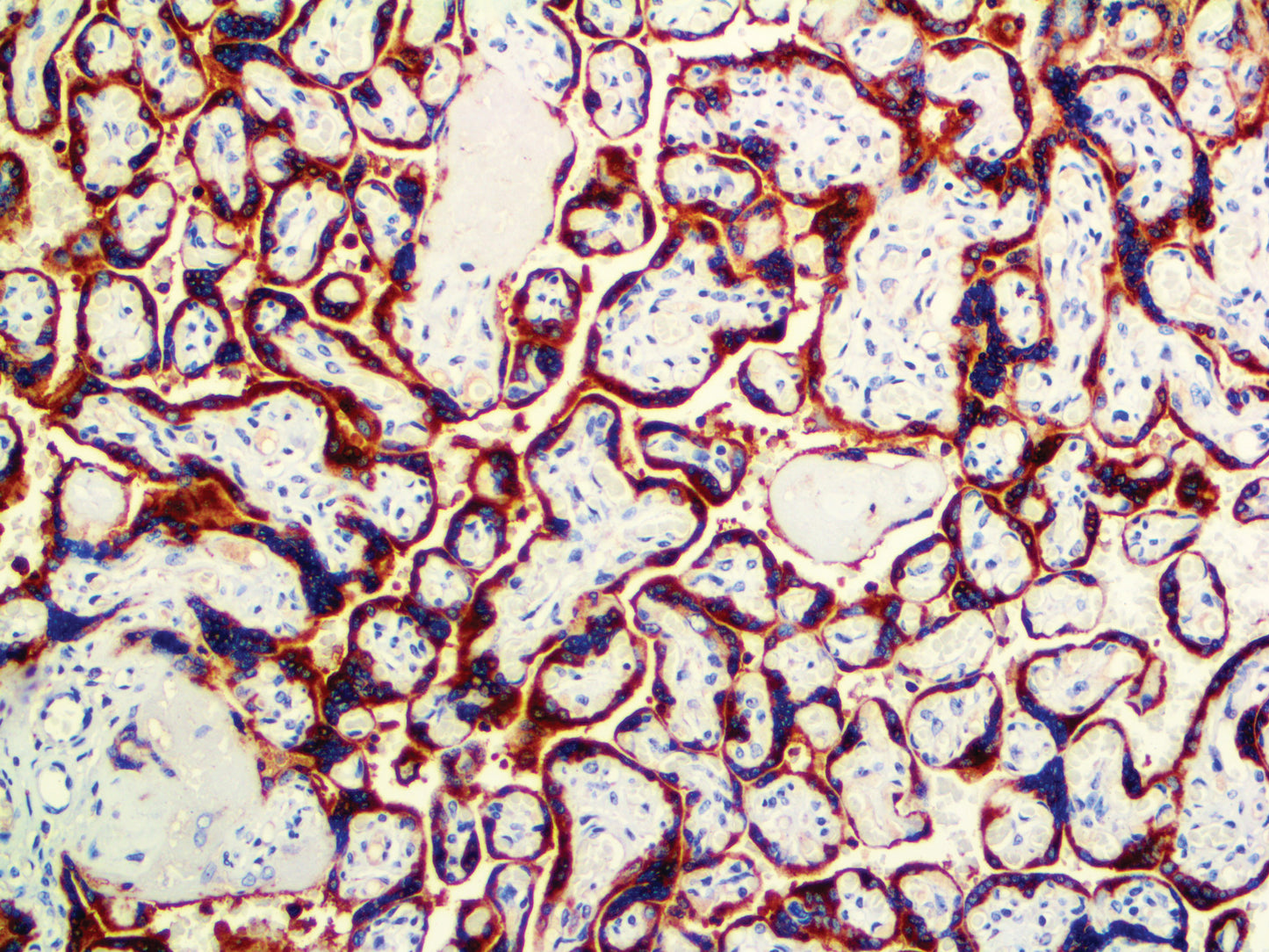
{"type":"root","children":[{"type":"paragraph","children":[{"type":"text","value":"Human placenta lactogen (hPL), also known as human chorionic somatomammotropin (HCS), is a polypeptide placental hormone. Its structure and function are similar to that of human growth hormone. It modifies the metabolic state of the mother during pregnancy to facilitate the energy supply of the fetus. It is first detectable in the maternal serum in the fifth week of gestation and reaches a plateau by the thirty-fourth week."}]},{"type":"paragraph","children":[{"type":"text","value":"hPL is expressed in the syncytiotrophoblastic cells of choriocarcinoma. A rare variant of trophoblastic tumor has been reported in the testis with resemblance to uterine placental site trophoblastic tumor. It consisted purely of intermediate trophoblasts, which was diffusely positive for hPL and focally for B-hCG."}]}]}
Antibody Type
Rabbit Monoclonal
Clone
EP241
Isotype
IgG
Localization
Cytoplasmic
Dilution
1:100-1:500
Species Reactivity
Human
Immunogen
A synthetic peptide corresponding to residues of human placental lactogen protein.