 US & Canada:
  Email:


 Access IFU & SDS
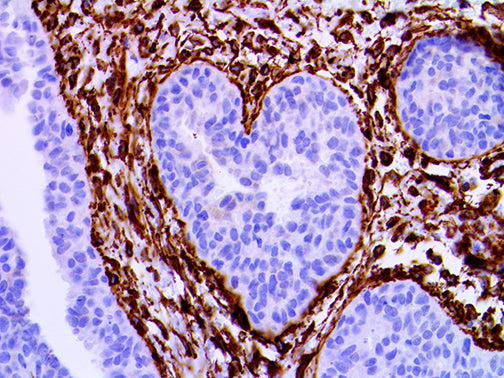
Summary & Explanation
{"type":"root","children":[{"type":"paragraph","children":[{"type":"text","value":"Beta-type Platelet-Derived Growth Factor Receptor is a protein that in humans is encoded by the PDGFRB gene. This gene encodes a cell surface tyrosine kinase receptor for members of the Platelet-Derived Growth Factor family (PDGF), which is a mitogen for mesenchyme- and glia-derived cells. PDGF consists of two chains, A and B, which dimerize to form functionally distinct isoforms, PGDF-AA, PDGF-AB and PDGF-BB."}]},{"type":"paragraph","children":[{"type":"text","value":"Translocation of the PDGFR gene with the Tel gene is linked to Chronic Myelomonocytic Leukemia (CMML), a myelodysplastic syndrome, and demonstrates the oncogenic potential of the PDGF receptors. A translocation between chromosomes 5 and 12, that fuses this gene to that of the translocation, ETV6, leukemia gene, results in chronic myeloproliferative disorder with eosinophilia."}]}]}
Antibody Type
Rabbit Monoclonal
Clone
RBT-PDGFRB
Isotype
IgG
Localization
Cytoplasmic, Membranous
Dilution
1:10-1:50
Species Reactivity
Human, Mouse, Rat
Immunogen
Highly pure (>98%) recombinant hPDGF-B (human Platelet Derived Growth Factor).