 US & Canada:
  Email:


 Access IFU & SDS
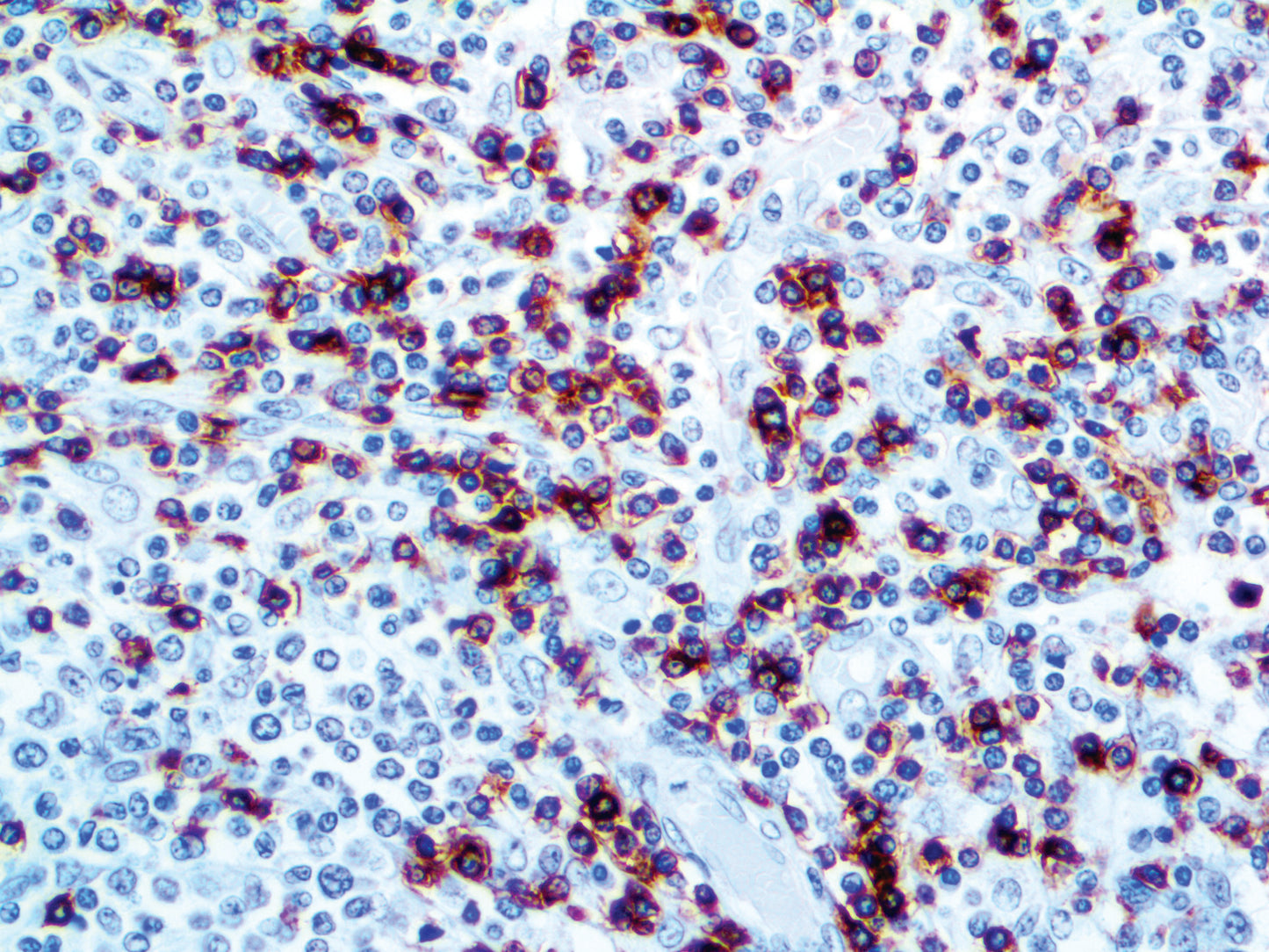
Summary & Explanation
{"type":"root","children":[{"type":"paragraph","children":[{"type":"text","value":"CD7 is a 40 kDa transmembrane, single-chain glycoprotein, which is a member of the immunoglobulin gene superfamily. It is expressed in the majority of immature and mature T-lymphocytes, and T-cell Leukemia. CD7 is also found in natural killer cells, a small subpopulation of normal B-cells and in malignant B-cells and it plays an essential role in T-cell interactions and also in T-cell/B-cell interaction during early lymphoid development."}]},{"type":"paragraph","children":[{"type":"text","value":"CD7 is a consistently-expressed T-cell antigen in Lymphoblastic Lymphomas and Leukemias; therefore, it is a useful marker in the identification of such neoplastic proliferations. CD7 is expressed in the majority of mature peripheral T-cells, the majority of post-thymic T-cells, NK cells, some myeloid cells, T-cell Acute Lymphoblastic Leukemia/Lymphoma, Acute Myelogenous Leukemia and Chronic Myelogenous Leukemia. Interestingly, CD7 is conspicuously absent in adult T-cell Leukemia/Lymphoma and is not expressed in Sezary cells."}]}]}
Antibody Type
Rabbit Monoclonal
Clone
EP132
Isotype
IgG
Localization
Membranous
Dilution
1:50-1:200
Species Reactivity
Human
Immunogen
Synthetic peptide corresponding to residues of the human CD7 protein.