 US & Canada:
  Email:


 Access IFU & SDS
Summary & Explanation
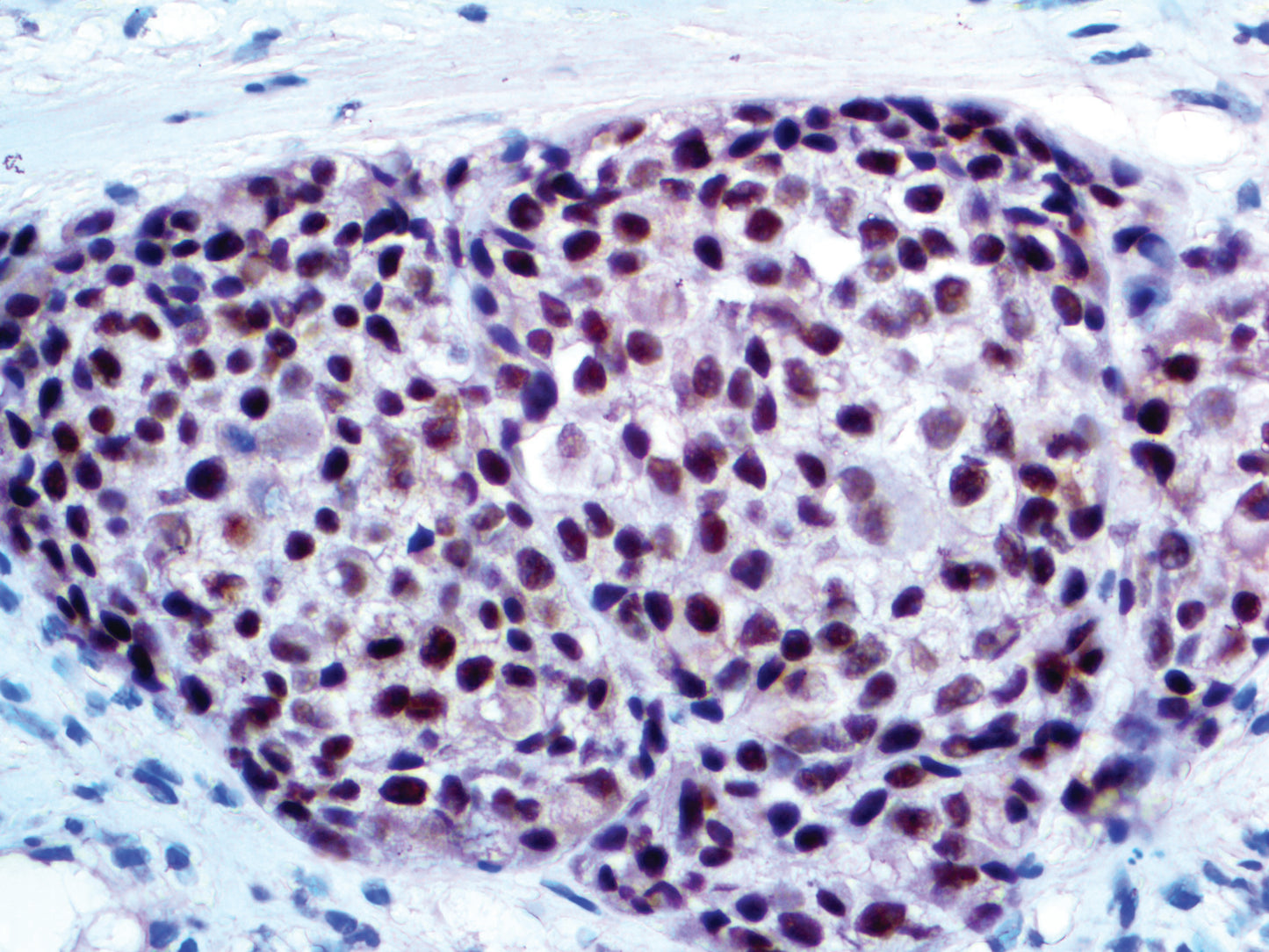
{"type":"root","children":[{"type":"paragraph","children":[{"type":"text","value":"Transcription factor SOX-10 is a member of the SOX (SRY-related HMG-box) family of transcription factors involved in the regulation of embryonic development and in the determination of the cell fate. The encoded protein may act as a transcriptional activator after forming a protein complex with other proteins. This protein acts as a nucleocytoplasmic shuttle protein and is important for neural crest and peripheral nervous system development. Mutations in this gene are associated with Waardenburg-Shah and Waardenburg-Hirschsprung disease. Anti-SOX-10 has been recently shown to be a sensitive marker of melanoma, including conventional, spindled, and desmoplastic subtypes."}]},{"type":"paragraph","children":[{"type":"text","value":"SOX-10 is expressed by metastatic melanomas and nodal capsular nevus in sentinel lymph nodes, but not by other lymph node components such as dendritic cells which usually express S100 protein. In scar specimens, immature fibroblasts, epithelioid granulomas, and histiocytic proliferations can histopathologically mimic residual melanoma and even be positive for MiTF and S100. However, SOX-10 is less likely to be expressed by fibroblasts or histiocytes, especially compared to MiTF and S100. Anti-SOX-10 produces a nuclear stain that provides a clean signal that is much sharper and darker in staining quality when compared to the use of antibodies against MiTF and S100."}]}]}
Antibody Type
Mouse Monoclonal
Clone
BSB-62
Isotype
IgG2b/K
Localization
Nuclear
Dilution
1:25-1:100
Species Reactivity
Human
Immunogen
A synthetic peptide corresponding to N-Terminus of human SOX-10.