 US & Canada:
  Email:


 Access IFU & SDS
Summary & Explanation
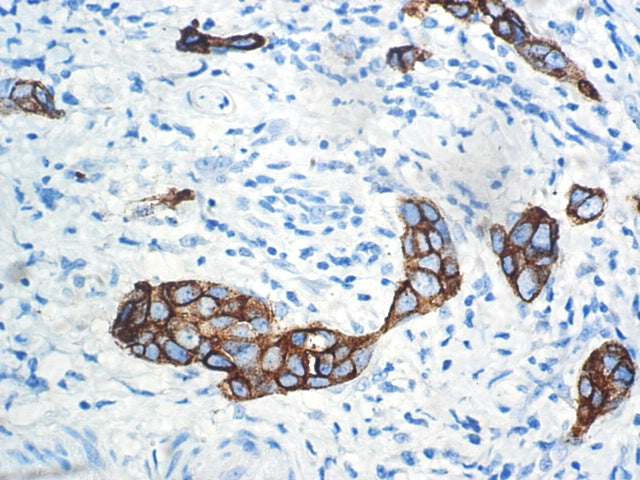
{"type":"root","children":[{"type":"paragraph","children":[{"type":"text","value":"This antibody has been used for evaluating the primary site of a metastatic carcinoma of unknown origin and distinguishing between benign and malignant lesions. It is believed that CA15-3 reacts primarily with the DF3-antigen, a 300 kDa mucin-like glycoprotein present on the apical border of secretory mammary\n epithelial cells."}]},{"type":"paragraph","children":[{"type":"text","value":"CA15-3 has been detected with immunohistochemistry in a wide spectrum of carcinomas, including Breast Carcinomas (ductal and lobular), Sarcomas (Synovial Sarcoma and Malignant Fibrous Histiocytomas), and Lung Carcinomas. CA15-3 can be used as a supplementary marker for epithelial differentiation. CA15-3 does\n not stain Melanomas or Ewing’s Sarcomas. Approximately 30% of Hepatocellular Carcinomas are positive for CA15-3."}]}]}
Antibody Type
Mouse Monoclonal
Clone
DF3
Isotype
IgG1/K
Localization
Cytoplasmic, Membranous
Dilution
1:250-1:1000
Species Reactivity
Human
Immunogen
Membrane enriched fractions of human metastatic breast carcinoma.